I am a social scientist, currently serving as head of the Scholarly Communication Research Group (associate professor at Faculty of Philosophy, Adam Mickiewicz University in Poznań, Poland) and associate professor at Faculty of Computer Science (West Pomeranian University of Technology in Szczecin, Poland). My academic background is in philosophy and communication, which has driven my passion for investigating critical aspects of scholarly communication. My research primarily focuses on the nuances of predatory publishing and the far-reaching consequences of research evaluation systems.
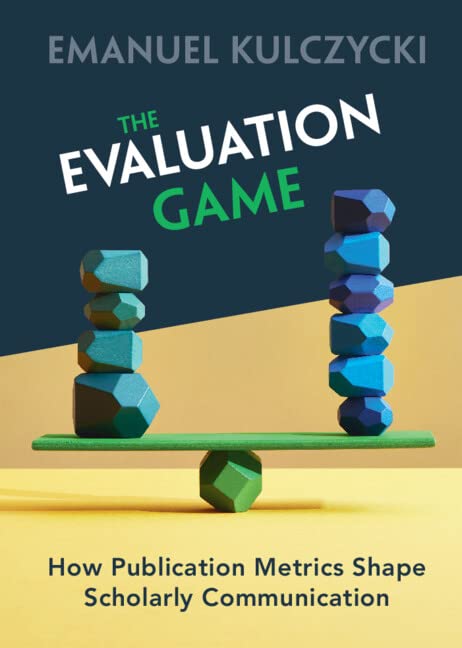
My new book is available now
Cambridge University Press (April 2023). See on the publisher website.
The Evaluation Game. How Publication Metrics Shape Scholarly Communication.
- Provides a comprehensive account of the transformations in scholarly communication generated by research evaluation systems, and proposes a fundamental rethinking of the values that drive academia.
- Presents the first historical account of research evaluation systems in the East, tracing them back to their roots in the modernization of Russia.
- Discusses the two distinct trajectories of modernisation and metricization in academia, the socialist and capitalist, allowing readers to understand why researchers in different regions react differently to research evaluation.
About my research
My research group has made major contributions to the understanding of the effects of research evaluation systems and transformations of scholarly communication in metricized academia. I address research problems from transdisciplinary perspectives, drawing on classical works in the sociology of science, higher education research, social studies of science, evaluation studies, critical university studies, and bibliometrics. I just believe that (social) reality is not categorized into disciplines but areas and practices worth exploring.
I want to use my research to improve academia. From 2018 to 2020, I was the chair of ENRESSH (European Network for Research Evaluation in the Social Sciences and the Humanities). In 2019, I co-founded the Helsinki Initiative on Multilingualism in Scholarly Communication. Moreover, I have been a policy advisor for the Ministry of Science and Higher Education in Poland since 2013.
As part of my research, I try to go beyond the walls of academia. Therefore, I write popular science articles and essays. For many years, I have conducted seminars and workshops on scholarly communication. From 2011 to 2020, I was writing an academic blog in Polish entitled Warsztat badacza (“Scholar’s Workshop”), where I discussed scholarly communication, research evaluation, science policy, and other issues related to the daily work of researchers.
Currently, I study three main areas. Below, I briefly describe my aims and approaches.
Evaluation game: effects of research evaluation systems
For the last few years, I have been working on the concept of the evaluation game. The book The Evaluation Game: How Publication Metrics Shape Scholarly Communication, in which I develop this idea, was published by Cambridge University Press in April 2023. The book is the product of my longstanding engagement with the field of research evaluation.
As the head of the SCRG AMU and a policy advisor to the Ministry of Education and Science in Poland, I have been invited to design and analyze multiple research evaluation systems and have published numerous papers on the topic. For instance, I investigate how publication patterns change under the influence of research evaluation systems.
Moreover, for many years I have been conducting research on the Polish research evaluation system regarding assessing publications, publication counting methods, and local use of national metrics.
Here you can find the Handbook on Research Assessment in the Social Sciences which I co-edited with Tim C.E. Engels.
Multilingualism in science
I do believe that research must be communicated in multiple languages. Access to research and more significant interaction between science and society can only be possible if research is communicated in multiple languages, including those actually used in speech and writing locally. In February 2022, as an invited speaker at the Paris Open Science European Conference, I argued that in the ongoing reform of the research assessment system, the call for multilingualism is the most notable omission. Multilingualism is integral to accessibility and should be part of the European research assessment reform.
You can watch my talk from Paris here and read blog posts on LSE Blog here and here.
Moreover, you can read my paper on multilingual publishing in the social sciences and humanities.
Geopolitics of scholarly communication
The ongoing discussion on predatory publishing and organizing predatory conferences needs a fresh theoretical perspective to fully take the geopolitical dimension into account. The geopolitical nature of predatory academia is twofold. On the one hand, discussions about predatory journals or conferences are often biased against outlets produced in peripheral countries. On the other hand, many studies show that the negative effects of predatory publishing are significantly more damaging to peripheral areas of knowledge production than to central ones.
My empirical research in the field of predatory academia relates to Dr. Fraud sting operation, the impact of Beall’s lists on investigating predatory journals, citation patterns including content-based analysis between impact-factor and predatory journals, and analysis of presenters from top-ranked universities at questionable conferences. My conceptual contribution is based on the concept of mislocated centers of scholarly communication that allows us to describe and criticize the role some publication channels play in the (semi)peripheries without condemning scholars who publish in them or accusing publishers of bad intentions.
You can watch my talk on the geopolitics of scholarly communication at the CWTS seminar here.